


- Aneurysm: a disease characterized by dilatation of the arterial wall that can affect all arteries in the body. Most frequently (80% of cases) the abdominal aorta is affected. The aneurysm tends to expand, so close surveillance is necessary. Progression of the aneurysm can lead to rupture of the vessel, resulting in bleeding and danger to the patient.
- Carotid artery stenosis: a disease characterized by narrowing (stenosis) of the internal carotid artery, which supplies blood to the brain. If the stenosis is severe, it can cause ischemic stroke. In the area of stenosis, small clots or fragments of plaque can dislodge due to blood flow turbulence and close the vessels supplying the brain.
- Chronic peripheral obstructive arteriopathy: a disease characterized by progressive narrowing (stenosis) to complete obstruction of arteries. It mainly affects the arteries of the lower limbs. The absence of blood is manifested by various clinical pictures ranging from difficulty walking to the appearance of pain and ulcers.
- Dissection: a disease characterized by a tear in the inner layer (intima) of the artery whereby blood flows into the vessel wall forcing the layers of the wall to separate. This event can lead to partial or complete reduction of blood supply to a particular organ or to rupture of the vessel. The most common site of this pathology is the thoracic aorta.
- Varicose veins: a disease characterized by dilatation of superficial veins. It represents the most frequent venous pathology and mainly affects the lower limbs. It can cause a wide spectrum of symptoms ranging from annoying swelling of the legs to the appearance of painful ulcerations with little tendency to heal.
- Deep venous thrombosis: a disease characterized by the formation of a thrombus (clotted blood) within a vein, predominantly affecting the deep venous circulation of the lower limbs. Although some cases are asymptomatic, frequently patients complain of pain, redness and swelling in the leg. The most serious complication of deep vein thrombosis occurs when the thrombus becomes mobilized and stuck at the veins of the lungs, blocking their blood flow (pulmonary embolism).
- Lymphedema: a disease characterized by abnormal accumulation of lymphatic fluid in tissues. The most common site is the lower extremities. The patient may complain of pain and swelling. It is mainly due to the absence or destruction of lymphatic vessels.
Vascular surgery and angiology
Vascular surgery is a branch of surgery that deals with the vessels of the body: arteries and veins. Diseases and traumas of the blood vessels are treated. It operates in close collaboration with angiology, providing care and treatment of circulation disorders in the legs, upper limbs, neck and abdomen.
What we treat
Circulatory diseases
Circulatory diseases are a widespread disease in industrialized countries and are among the leading causes of hospitalization in Switzerland with high costs to ensure their treatment.
Due to the occurrence of atherosclerosis (hardening of the vessel and the appearance of real encrustations based on deposits of minerals such as calcium and fats such as cholesterol) arteries can narrow (technical term: stenosis) or dilate (technical term: aneurysm) causing the onset of symptoms and complications respectively defined as ischemia (blood struggles or fails to reach vital organs) or hemorrhage (vessels rupture and blood escapes causing bleeding that can be fatal).
The pathology of veins represents a clinical problem quite distinct from that of arteries, but no less important. Dilatation of these vessels (venous insufficiency) and/or clotting of the blood within them can result in a wide spectrum of clinical pictures ranging from nuanced forms such as heaviness in the legs and unsightly capillaries to more severe ones that include varicose veins, phlebitis, and venous ulcers. The latter are often located in the lower limbs and result in intense pain and disability.
However, the conditions exist to address these health and social difficulties with hope. In fact, circulatory diseases are largely preventable, at least 50 percent through proper lifestyle information and reduction of risk factors. Diagnostic screening examinations are simple and can detect a problem before it is too late to ensure proper treatment.
Diagnosis and treatment
Diagnosis
Angiologic and vascular surgical examinations can rely on the support of the best technologies and the advice of physicians from other specialties (anesthesiologists, cardiologists, neurologists, nephrologists, endocrinologists).
Alongside the clinical examination, various diagnostic techniques are available to identify diseases affecting the veins and blood vessels:
- Blood tests: for example, evaluation of D-Dimer, a breakdown product of fibrin, a protein responsible for the formation of clots (thrombi) in blood vessels.
- Vascular plethysmography: a noninvasive tool for assessing arterial flow.
- Ankle/Arm Index (ABI) also called the Winsor index, measures the overall vascularity of a limb.
- Exercise testing (without and with a treadmill).
- Transcutaneous oxygen measurement: quantification of oxygen reaching the tissues, which indirectly represents a measure of residual arterial function.
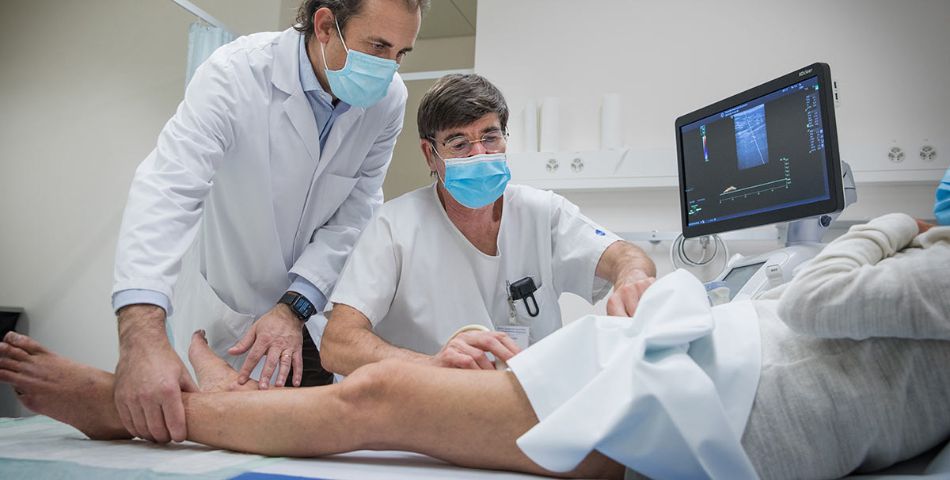
- Echo-color doppler (duplex): special vascular sonography, which allows noninvasive visualization of the artery and evaluation of its morphology and flow. It allows to detect the presence of narrowing and/or thrombi within the arteries, as well as to assess the functional capacity of the veins.
- Computerized Angio-Computed Tomography (angio-CT), Magnetic Angio-Resonance Imaging (angio-MRI): second-level examinations that allow accurate assessment of the vessels. It is mainly performed to plan invasive procedures.
Invasive treatments
Theaneurysm is treated by:
- Open aortic replacement surgery, which aims to exclude the aneurysm from the bloodstream by restoring the blood pathway using a synthetic vascular prosthesis. Through an opening of the abdominal cavity, the surgeon blocks the aorta with a clamp, opens the aneurysm, and replaces it with a vascular prosthesis.
- Endovascular therapy: it is possible to exclude the aneurysm from the blood circulation by inserting, through the arteries in the inguinal region, an endoprosthesis that consists of a tubular metal mesh (stent) covered with a thin layer of tissue. The endoprosthesis folded into a catheter is released into a healthy aorta treaty where it is able to anchor itself due to its expanding force. Blood will flow into the endoprosthesis, reducing the pressure on the arterial wall, which can no longer rupture.
Carotid artery stenosis can be treated through:
- Carotid endarterectomy (TEA): surgery that aims to physically remove the atherosclerotic plaque that narrows the carotid artery.
- Percutaneous Transluminal Angioplasty (PTA) and Stenting: without actual surgery, the narrowed artery is dilated with a balloon and a wire mesh cylinder (stent) is placed to keep the lumen of the vessel open and prevent the mobilization of small fragments that can form by crushing the plaque.
In cases of chronic obstructive peripheral arteriopathy (AOCP), surgical treatment is aimed at improving walking autonomy, disappearing pain, healing ulcers, and excluding or minimizing limb amputation surgery. Surgical techniques include:
- Bypass: creation of a "bridge" that diverts blood flow from the occluded tract and ensures downstream supply. It can be packed with either the patient's own veins or synthetic prostheses.
- Thromboendoarterectomy: removal of obstruction by cleansing arteries aimed at removing atherosclerotic plaque from the vessel lumen.
- Angioplasty/stenting: endovascular procedure in order to dilate the artery with a balloon (angioplasty) and/or a stent (wire mesh) in order to increase blood flow. Endovascular procedures are very effective particularly in patients with diabetes or chronic renal failure. They are often performed in conjunction with surgery (hybrid surgeries) to maximize the chances of success and ensure lasting recovery.
Management of aortic dissection depends on the aortic segment involved:
- Dissections involving the first part of the aorta(Type A Dissections) require surgery that is managed by the cardiac surgeon.
- Dissections involving the second part of the aorta(Type B Dissections) can typically be treated with medical therapy by blood pressure reduction and control.
- Visceral and abdominal segment dilatation is taken over by the vascular surgeon. If ischemic and/or hemorrhagic complications occur, the two referring specialists (cardiac surgeon and vascular surgeon) work together to be able to offer endovascular or hybrid (surgery + endovascular) treatment in order to stop bleeding and restore flow at the level of the various organs.
The ability to take advantage of a Hybrid Room, which combines the qualities of a traditional surgical room with those of an angiography room, allows special emphasis to be placed on the use of minimally invasive techniques such as endovascular treatment of aortic aneurysms. Hybrid treatment (open surgery + stent implantation) allows the treatment of obstructive aorto-iliac-femoral-tibial disease responsible for claudication intermittens (the need to stop after a few meters of walking due to the appearance of pain in the buttocks or calves) and critical ischemia (the appearance of pain at rest or trophic lesions) particularly in the diabetic patient.
An integrated approach between angiologist and vascular surgeon ensures the treatment of Chronic Superficial Venous Insufficiency (IVCS), capillaries, and varices of the great and small saphenous veins, either by traditional surgical technique, endoscopic (Laser) or using sclerosing therapy.
Medical Treatments
Vessel diseases, in addition to surgical interventions (vascular surgery), can be treated by various pathology-specific medical techniques.
Arteriopathies:
- Exercise in walking.
- Correction of cardiovascular risk factors.
- Medications (e.g., antiplatelet and anticoagulants).
Venous diseases:
- Veno-active medications.
- Elastic restraint (stocking).
- Vein removal by methods with reduced invasiveness (sclerotherapy).
Lymphedema:
- Scrupulous skin care.
- Lymphatic drainage.
- Specific bandages.
- Targeted physiotherapy.
Patient services
Support services

Dedicated services
Insights
Internal EOC collaborations.
A close synergy between the Servizio di Chirurgia vascolare and Angiologia EOC and il Servizio di Cardiochirurgia has developed and is fully active at the Istituto Cardiocentro Ticino. This collaboration spans multiple fronts, embracing the diagnostic dimension-with angiologists providing their expertise in the medical management of peripheral vascular disease-and the integrated therapeutic approach, in which vascular surgeons and cardiac surgeons work together for the management of specific thoraco-abdominal pathologies, both in planned and emergency settings. This synergy between medical specialties is strongly geared toward providing patients with high-standard care, ensuring effective, innovative, and highly targeted medical and surgical solutions.
Frequently asked questions
How does the treatment begin?
All treatments begin with a couple's interview that usually lasts about an hour. For this reason (as the most important information is provided) it is essential that both partners are present.
What documents to bring with you?
It is useful, if possible, to send already in advance by e-mail or mail a summary with photocopies of the analyses or interventions already performed, so that we can prepare more appropriately for the discussion with you as well as to avoid unnecessary analyses. If you are interested in treatment with a heterologous insemination (sperm donation), it is very important to bring a copy of the document certifying blood type (for both wife and husband) as well as a confirmation of marriage.
Do you need to be married to access the treatments?
In the case of treatment with donor sperm, according to Swiss law, the couple must be legally married.
Are same-sex couples eligible for treatment?
Yes, same-sex female couples legally married in Switzerland can access assisted fertilization treatments with donor sperm.
Recognized training center
Vascular Surgery at Ospedale Regionale di Lugano is the only Ticino branch recognized for training in Vascular Surgery for physicians, by the Swiss Institute for Further Education (ISFM).
Center for Vascular Medicine
Through close interdisciplinary collaboration with the interventional radiology service, the Vascular Surgery and Angiology Service of the EOC forms the Ticino Vascular Center, which has been granted the recognition of national importance as a Center for Vascular Medicine by the Union of Swiss Societies of Vascular Diseases.

Contacts
Ambulatorio di Angiologia
Ospedale Regionale di Bellinzona, San Giovanni
-
Orari di risposta al telefono
Monday : 08:30 - 11:30 / 13:30 - 16:00
Tuesday : 08:30 - 11:30 / 13:30 - 16:00
Thursday : 08:30 - 11:30 / 13:30 - 16:00
Friday : 08:30 - 11:30 / 13:30 - 16:00
-
Chiusura dell’ambulatorio
Wednesday
Saturday
Sunday
Ambulatorio di Angiologia
Ospedale Regionale di Mendrisio, Beata Vergine
-
Orari di risposta al telefono
Monday : 08:30 - 12:00 / 13:30 - 16:30
Tuesday : 08:30 - 12:00 / 13:30 - 16:30
Wednesday : 08:30 - 12:00 / 13:30 - 16:30
Thursday : 08:30 - 12:00 / 13:30 - 16:30
Friday : 08:30 - 12:00 / 13:30 - 16:30
-
Chiusura dell’ambulatorio
Saturday
Sunday
Ambulatorio di Angiologia
Ospedale Regionale di Lugano, Italiano
-
Orari di risposta al telefono
Monday : 08:30 - 12:00 / 13:30 - 16:30
Tuesday : 08:30 - 12:00 / 13:30 - 16:30
Wednesday : 08:30 - 12:00 / 13:30 - 16:30
Thursday : 08:30 - 12:00 / 13:30 - 16:30
Friday : 08:30 - 12:00 / 13:30 - 16:30
-
Chiusura dell’ambulatorio
Saturday
Sunday
Ambulatorio di Angiologia
Ospedale Regionale di Lugano, Civico
-
Orari di risposta al telefono
Monday : 08:30 - 11:30 / 13:00 - 16:00
Tuesday : 08:30 - 11:30 / 13:00 - 16:00
Wednesday : 08:30 - 11:30 / 13:00 - 16:00
Thursday : 08:30 - 11:30 / 13:00 - 16:00
Friday : 08:30 - 11:30 / 13:00 - 16:00
-
Chiusura dell’ambulatorio
Saturday
Sunday
Ambulatorio di Angiologia
Ospedale Regionale di Locarno, La Carità
-
Orari di risposta al telefono
Monday : 08:00 - 12:00 / 13:00 - 16:30
Tuesday : 08:00 - 12:00 / 13:00 - 16:30
Wednesday : 08:00 - 12:00 / 13:00 - 16:30
Thursday : 08:00 - 12:00 / 13:00 - 16:30
Friday : 08:00 - 12:00 / 13:00 - 16:30
-
Chiusura dell’ambulatorio
Saturday
Sunday
Ambulatorio di Chirurgia vascolare
Ospedale Regionale di Bellinzona, San Giovanni
-
Orari di risposta al telefono
Monday : 08:30 - 11:30 / 13:30 - 16:00
Tuesday : 08:30 - 11:30 / 13:30 - 16:00
Wednesday : 08:30 - 11:30 / 13:30 - 16:00
Thursday : 08:30 - 11:30 / 13:30 - 16:00
Friday : 08:30 - 11:30 / 13:30 - 16:00
-
Chiusura dell’ambulatorio
Saturday
Sunday
Ambulatorio di Chirurgia vascolare
Ospedale Regionale di Locarno, La Carità
-
Orari di risposta al telefono
Monday : 08:30 - 11:30 / 14:00 - 16:00
Tuesday : 08:30 - 11:30 / 14:00 - 16:00
Wednesday : 08:30 - 11:30 / 14:00 - 16:00
Thursday : 08:30 - 11:30 / 14:00 - 16:00
Friday : 08:30 - 11:30 / 14:00 - 16:00
-
Chiusura dell’ambulatorio
Saturday
Sunday
Ambulatorio di Chirurgia vascolare
Ospedale Regionale di Mendrisio, Beata Vergine
-
Orari di risposta al telefono
Monday : 08:30 - 12:00 / 13:30 - 16:30
Tuesday : 08:30 - 12:00 / 13:30 - 16:30
Wednesday : 08:30 - 12:00 / 13:30 - 16:30
Thursday : 08:30 - 12:00 / 13:30 - 16:30
Friday : 08:30 - 12:00 / 13:30 - 16:30
-
Chiusura dell’ambulatorio
Saturday
Sunday
Ambulatorio di Chirurgia vascolare
Ospedale Regionale di Lugano, Civico
-
Orari di risposta al telefono
Monday : 08:30 - 11:30 / 13:00 - 16:00
Tuesday : 08:30 - 11:30 / 13:00 - 16:00
Wednesday : 08:30 - 11:30 / 13:00 - 16:00
Thursday : 08:30 - 11:30 / 13:00 - 16:00
Friday : 08:30 - 11:30 / 13:00 - 16:00
-
Chiusura dell’ambulatorio
Saturday
Sunday
Related News






Eventi
Currently there are no scheduled events or trainings, discover past events.
Locations
Vascular surgery and angiology services are provided at the four main EOC hospital sites. Preoperative assessments and postoperative follow-up visits are organized in the four regional hospitals. As for interventions, the most complex and multidisciplinary ones are performed at the Ospedale Regionale di Lugano (Civico). Less high-risk interventions are also performed at the other EOC Hospitals.
The English version of this page was created with the aid of automatic translation tools and may contain errors and omissions.
The original version is the page in Italian.
