

The task of the pain therapy specialist is to recognize the cause of pain, suggesting the most appropriate therapeutic strategy from time to time, not only pharmacological in nature.
Pain management

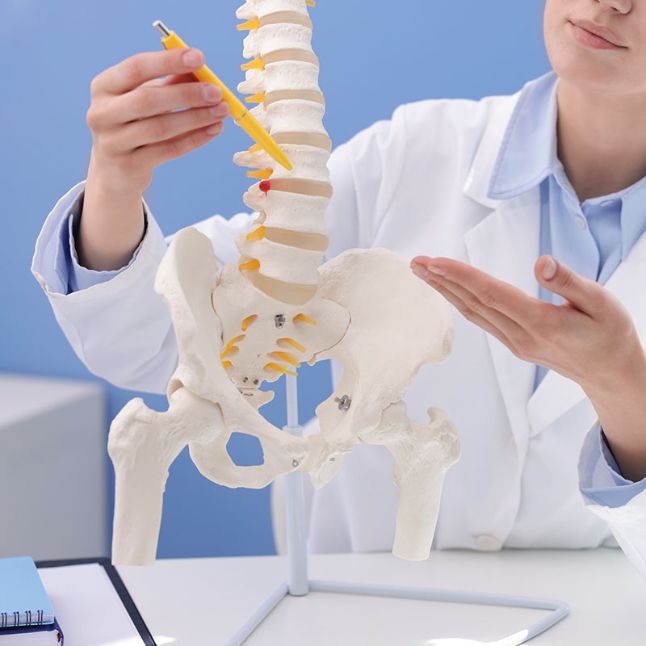
Chronic pain is not just a symptom but a disease. The pain management specialist has the knowledge to define the cause of pain as well as the ability and tools to control it.
The specialty
What we treat
Non-neoplastic painful conditions such as:
- Lumbago: back pain.
- Discogenic pain: pain usually affecting the lower back near the junction of the lumbar and sacrum.
- Pain of degenerative origin: e.g., osteoarthritis, the main cause of chronic joint pain.
- Facetopathy: arthrosis-based degeneration of the articular surfaces (facet joints) between two or more neighboring vertebrae.
- Sciatalgia: pain along the territory innervated by the sciatic nerve on disc protrusions, disc herniation, canal stenosis.
- Persistent spinal pain after surgery.
- Neuropathy: impaired function of the peripheral nervous system, resulting in motor difficulties and/or sensory abnormalities.
- Postherpetic neuralgia: chronic pain in a skin area innervated by nerves infected with the shingles virus (shingles).
- Post-stroke pain: neuropathic pain in a part of the body that has had sensation impaired due to a stroke.
- Diabetic or small fiberneuropathy pain.
- Fibromyalgia: disorder that causes generalized pain and soreness, extreme exhaustion, and sleep problems.
- Tensive headache: causes mild generalized pain (usually constrictive), without the functional inability, nausea or photophobia that are associated with migraine.
- Algodystrophies: chronic pain condition localized to the lower or upper extremities and usually associated with edema.
- Pain of an ischemic nature on arteriopathy.
- Meralgia: pain in the outer thigh due to compression of the lateral femoral cutaneous nerve.
- Pelvic pain: discomfort in the lower abdomen.
- Radicular pain: radiating pain along the course of a nerve root (in most cases of the limbs).
- Phantom limb syndrome: pain felt by the brain in a limb that it no longer has, as it has been amputated as a result of disease or trauma.
- Meralgia parestetica: a neurological disorder characterized by altered skin sensory perception in the upper and outer thigh.
- Myofascial syndrome: pain in and around the masticatory structures or referred to other sites in the head and neck, caused by muscle tension, fatigue or spasm in the masticatory muscles.
- Facial paingia: temporomandibular pain, trigeminal neuralgia, occipital neuralgia.
Diagnosis and treatment
Diagnosis on the origin of pain is made after specialist medical evaluation and possible completion with neuroradiological and neurophysiological examinations. There are several procedures for the diagnosis and treatment of chronic pain:
- Blocking of cervical, thoracic and lumbar medial joint branches: the facet joints are the two posterior bearing surfaces of two adjacent vertebrae, innervated by sensory nerve branches called medial joint branches that transmit information from these joints to the brain. Local anesthetic is administered near the responsible nerve. The purpose of the procedure is to identify the source of pain by blocking the transmission of the impulse from the facet joint hypothesized to be involved.
- Stellate ganglion block: an outpatient infiltrative procedure for the treatment of pain syndromes of the head, neck, and upper extremity in which the sympathetic nervous system is involved.
- Lumbar and sacral sympathetic nervous system block (Impar ganglion, celiac ganglion): infiltrative procedure for the investigation and/or treatment of lower limb pain syndromes in which the sympathetic nervous system is involved.
- Provocative discography: diagnostic procedure with the aim of identifying which intervertebral disc is responsible for pain.
- Lumbar transforaminal epidural infiltration or selective (periradicular)block: local anesthetic and cortisone is applied at the level of the nerve root emergence hole. The purpose of this procedure is both diagnostic, to identify the involved nerve root, and therapeutic to reduce inflammation.
- Cervical, thoracic or lumbar translaminar epidural infiltration: cortisone is administered into the epidural space to reduce inflammation. A local anesthetic is also administered, the purpose of which is to immediately relieve pain and help physicians identify the cause of pain.
- Selective denervation by radiofrequency (thermoneurolysis) of the medial joint branches: in cases where blocks on the medial joint branches have been successful (temporary disappearance of pain), denervation treatment is performed, which consists of placing a needle near the nerve. The needle tip is heated to 80°C for two minutes by radiofrequency waves. This allows targeted cauterization of the nerve and interruption of pain conduction.
Patient services
Support services
Dedicated services
Insights
Neuromodulation and the treatment of refractory pain
The EOC Pain Therapy Center is at the forefront of neuromodulation and can offer all the latest techniques for the treatment of refractory pain. PD Dr. med. P. Maino in September 2013 was the first in Switzerland to perform a dorsal ganglion neurostimulation implant for the treatment of refractory neuropathic pain caused by injury to peripheral nerve structures.
What is the neurostimulator
The neurostimulator is a device that is placed on an outpatient basis and is used to treat predominantly chronic neuropathic pain refractory to conservative therapies.
Neuromodulation techniques
- Perimedullary Neuromodulation (Spinal Cord Stimulation).
Neuromodulation is a system consisting of electrodes that are implanted in the epidural space and are connected to a small electrical generator placed under the skin. Its function is to interfere through the application of electrical impulses to the cord or peripheral nerve structures with the pain transmission pathways to the brain. Pain is thus covered with a pleasant tingling/vibrating sensation. - Dorsal ganglion neuromodulation (DRG).
Dorsal root ganglion neurostimulation is an innovative technique to selectively control chronic pain caused by peripheral nervous system lesions affecting parts of the body that are difficult to reach with the normal spinal cord stimulation technique such as the groin or chest region or to the limbs in limited areas. This mode of stimulation has also proved useful in algodystrophies.
Am I a candidate for the neurostimulator?
The neurostimulator is offered to patients with chronic neuropathic pain refractory to conventional therapies. These pains can be either peripheral, involving the extremities, or lumbosacral for example after spinal surgery.
How does the placement of a neurostimulator take place?
The placement of a neurostimulator occurs in two stages:
- In the first phase, called the trial phase, through a special needle, electrodes are placed at the level of the epidural space. These emerge from the skin and are connected to an external generator so that the effectiveness of the technique can be tested before the final implantation. The duration of the trial phase is approximately 1-2 weeks. During this phase, the patient will need to regularly come to our center for checks and possible adjustments of the stimulation.
- In case of success and patient satisfaction, we proceed to the second phase, called the definitive phase, in which the external generator is replaced by a small battery that is placed under the skin. In case the test has no effect, the electrodes are removed.
The duration of both procedures is about 1 to 2 hours, and a 6-hour fast is required.
How are the procedures carried out?
In both phases, a venous access is placed through which sedation medication and an antibiotic to prevent infectious complications will be administered. In the first phase, the patient is placed on a couch in a prone position, while in the second phase the position is on the side or supine.
Where are the electrodes and battery placed?
Normally, for lower back or lower extremity pain, electrodes are most frequently placedat the thoracic peridural area behind the spinal cord and are inserted through a needle. The battery may be placed at the level of theabdomen lateral to the umbilicus or in the gluteal region.
The intrathecal pump
This is a system performed in two stages on an outpatient basis that allows drugs to be administered directly into the spinal canal.
The intrathecal pump is composed of a catheter, placed inside the spinal canal, which is connected to a small reservoir pump applied under the skin, at the abdominal level thanks to which it is possible to constantly administer drugs in the space called subarachnoid or intrathecal. The reservoir must be regularly refilled, usually every 4-6 weeks, through the insertion of a small needle through the skin.
What is the effectiveness of the intrathecal pump?
The efficacy of an intrathecal pump is greater than therapy taken orally because the drug is directly infused into the cephalorachid fluid near the nerve structures. Typically, a dosage of 1/300th of that taken orally is required to achieve the same effect. The purpose of the pump is to achieve better control of symptoms while minimizing side effects.
Am I a candidate for an intrathecal pump?
Patients with chronic pain refractory to conservative therapies or intolerant to orally administered preparations are candidates for an intrathecal pump.
This technique may also be indicated for patients who, due to severe disease or advanced age, cannot undergo surgery. The intrathecal pump may be proposed in the case of benign chronic pain or cancer pain. It is also a viable option for the treatment of spasticity in the context of neurological diseases (e.g., multiple sclerosis, after cerebral ischemic events, brain or spinal cord damage).
How does the installation of an intrathecal pump take place?
The placement of an intrathecal pump is done in two stages:
- In the first phase, called the trial phase, the catheter is placed through a special needle at the level of the intrathecal space. This is then connected to an external pump so that the patient can test the effectiveness of the technique. The duration of this phase is approximately 15 to 20 days. During this phase, the patient will need to regularly come to the center for targeted follow-ups.
- In case of success and patient satisfaction, the second phase, the definitive phase, is carried out, in which the external system is replaced by a small pump that is placed under the skin at the abdominal level.
Both phases are performed undergeneral anesthesia, so a 6-hour fast is required. The duration of the procedures is about 1 to 2 hours.
How are the procedures carried out?
In both phases, a venous access is placed through which an antibiotic is administered to prevent infectious complications. In the first phase, the patient is placed on a couch in a prone position, while in the second phase the position is on the side or supine.
Preparation for treatment
Before treatment: by agreement with the treating physician or cardiologist, discontinue specific medications:
- Antiplatelets (Plavix, Aspirin-Cardio, Clopidogrel): 1 week before.
- Anticoagulants of the vitamin K inhibitor class (Sintrom, Marcoumar): at least 1 week before with INR and Quick check by your attending physician the day before (INR minimum value less than or equal to 1.4 and Quick >70%).
- Anticoagulants of NOAK class (Xarelto, Eliquis, Pradaxa, Lixiana): at least 72 hours before.
- Low molecular weight heparins (Fragmin, Fraxiparin, Clexane): 24 hours before.
For cervical-level procedures, for radiofrequency thermocoagulation, no food should be eaten in the 6 hours before surgery; water/tea may be drunk until 2 hours before surgery.
In Hospital:
- Bring medical reports or radiological examinations in your possession.
- Arrive 30 minutes early to announce yourself at the reception and take care of paperwork, etc.
After treatment: patients should be taken home, not driving any kind of vehicle until the next morning.
The EOC Pain Therapy Center.
The Center for Pain Therapy of the Institute of Clinical Neuroscience of the Italian-speaking part of Switzerland:
- It is an interdisciplinary facility that, in the spinal area, is organized according to the guidelines of the Spine Intervention Society. The specialists active in the center have undergone specific training recognized by the "Swiss Society of Interventional Pain Medicine" and ensure the application of international protocols in the diagnostic and therapeutic fields.
- It relies on close collaboration between the specialties operating within the Neurocenter (neurology, neurosurgery, interventional neuroradiology, sleep medicine) and other specialties, such as internal medicine, rheumatology, orthopedics, physiatry, psychiatry, and social services.
The goals of the center are:
- Provide appropriate diagnosis and treatment for patients with chronic pain that has persisted for more than three months.
- Relieve psychological and behavioral dysfunctions related to the disease "pain."
- Promote reintegration into the patient's social, family and work life.
- Rationalize drug therapy.
- Reduce the patient's disabling condition.
- Offer the full spectrum of invasive and non-invasive treatments for the diagnosis and treatment of chronic pain.
Spine board
Each week, the EOC Pain Therapy Center's medical specialists discuss the most complex cases in an interdisciplinary manner with neurosurgeons and neuroradiologists, so as to ensure the best possible care for the patient.

Contact
Istituto di Neuroscienze Cliniche della Svizzera Italiana
Ambulatorio di Ipnosi
Ospedale Regionale di Bellinzona, San Giovanni
-
Orari di risposta al telefono
Monday : 08:30 - 11:30 / 13:30 - 16:00
Tuesday : 08:30 - 11:30 / 13:30 - 16:00
Wednesday : 08:30 - 11:30 / 13:30 - 16:00
Thursday : 08:30 - 11:30 / 13:30 - 16:00
Friday : 08:30 - 11:30 / 13:30 - 16:00
-
Chiusura dell’ambulatorio
Saturday
Sunday
Istituto di Neuroscienze Cliniche della Svizzera Italiana
Ambulatorio di Ipnosi
Ospedale Regionale di Mendrisio, Beata Vergine
-
Orari di risposta al telefono
Monday : 08:30 - 12:00 / 13:30 - 16:30
Tuesday : 08:30 - 12:00 / 13:30 - 16:30
Wednesday : 08:30 - 12:00 / 13:30 - 16:30
Thursday : 08:30 - 12:00 / 13:30 - 16:30
Friday : 08:30 - 12:00 / 13:30 - 16:30
-
Chiusura dell’ambulatorio
Saturday
Sunday
Istituto di Neuroscienze Cliniche della Svizzera Italiana
Ambulatorio di Ipnosi
Ospedale Regionale di Lugano, Italiano
-
Orari di risposta al telefono
Monday : 09:00 - 11:00 / 14:00 - 16:00
Tuesday : 09:00 - 11:00 / 14:00 - 16:00
Wednesday : 09:00 - 11:00 / 14:00 - 16:00
Thursday : 09:00 - 11:00 / 14:00 - 16:00
Friday : 09:00 - 11:00 / 14:00 - 16:00
-
Chiusura dell’ambulatorio
Saturday
Sunday
Istituto di Neuroscienze Cliniche della Svizzera Italiana
Ambulatorio di Medicina cinese
Ospedale Regionale di Locarno, La Carità
È possibile prendere appuntamento con il Dr. Peloni e i terapisti Petrarolo, Wang e Vella.
-
Orari di risposta al telefono
Monday : 08:00 - 11:30 / 13:00 - 16:00
Tuesday : 08:00 - 11:30 / 13:00 - 16:00
Wednesday : 08:00 - 11:30 / 13:00 - 16:00
Thursday : 08:00 - 11:30 / 13:00 - 16:00
Friday : 08:00 - 11:30 / 13:00 - 16:00
-
Chiusura dell’ambulatorio
Saturday
Sunday
Istituto di Neuroscienze Cliniche della Svizzera Italiana
Ambulatorio di Medicina cinese
Ospedale Regionale di Mendrisio, Beata Vergine
È possibile prendere appuntamento con il naturopata Cheng e il Dr. Peloni.
-
Orari di risposta al telefono
Monday : 08:30 - 12:00 / 13:30 - 16:00
Tuesday : 08:30 - 12:00 / 13:30 - 16:00
Wednesday : 08:30 - 12:00 / 13:30 - 16:00
Thursday : 08:30 - 12:00 / 13:30 - 16:00
Friday : 08:30 - 12:00 / 13:30 - 16:00
-
Chiusura dell’ambulatorio
Saturday afternoon
Sunday
Istituto di Neuroscienze Cliniche della Svizzera Italiana
Ambulatorio di Medicina cinese
Ospedale Regionale di Bellinzona, San Giovanni
È possibile prendere appuntamento con il Dr. Peloni.
-
Orari di risposta al telefono
Monday : 08:30 - 11:30 / 13:30 - 16:30
Tuesday : 08:30 - 11:30 / 13:30 - 16:30
Wednesday : 08:30 - 11:30 / 13:30 - 16:30
Thursday : 08:30 - 11:30 / 13:30 - 16:30
Friday : 08:30 - 11:30 / 13:30 - 16:30
-
Chiusura dell’ambulatorio
Saturday
Sunday
Istituto di Neuroscienze Cliniche della Svizzera Italiana
Ambulatorio di Medicina cinese
Ospedale Regionale di Lugano, Italiano
È possibile prendere appuntamento con la Dr.ssa Massaro e con la naturopata Merlini.
-
Orari di risposta al telefono
Monday : 09:00 - 11:00 / 14:00 - 16:00
Tuesday : 09:00 - 11:00 / 14:00 - 16:00
Wednesday : 09:00 - 11:00 / 14:00 - 16:00
Thursday : 09:00 - 11:00 / 14:00 - 16:00
Friday : 09:00 - 11:00 / 14:00 - 16:00
-
Chiusura dell’ambulatorio
Saturday
Sunday
Istituto di Neuroscienze Cliniche della Svizzera Italiana
Ambulatorio di Terapia del dolore
Ospedale Regionale di Locarno, La Carità
-
Orari di risposta al telefono
Monday : 09:00 - 11:00 / 14:00 - 16:00
Tuesday : 09:00 - 11:00 / 14:00 - 16:00
Wednesday : 09:00 - 11:00 / 14:00 - 16:00
Thursday : 09:00 - 11:00 / 14:00 - 16:00
Friday : 09:00 - 11:00 / 14:00 - 16:00
-
Chiusura dell’ambulatorio
Wednesday
Friday
Saturday
Sunday
Istituto di Neuroscienze Cliniche della Svizzera Italiana
Ambulatorio di Terapia del dolore
Ospedale Regionale di Bellinzona, Acquarossa
-
Orari di risposta al telefono
Monday : 09:00 - 11:00 / 13:30 - 16:00
Tuesday : 09:00 - 11:00 / 13:30 - 16:00
Wednesday : 09:00 - 11:00 / 13:30 - 16:00
Thursday : 09:00 - 11:00 / 13:30 - 16:00
Friday : 09:00 - 11:00 / 13:30 - 16:00
-
Chiusura dell’ambulatorio
Monday morning
Tuesday
Wednesday
Thursday
Friday
Saturday
Sunday
Istituto di Neuroscienze Cliniche della Svizzera Italiana
Ambulatorio di Terapia del dolore
Ospedale Regionale di Mendrisio, Beata Vergine
-
Orari di risposta al telefono
Monday : 09:00 - 11:00 / 14:00 - 16:00
Tuesday : 09:00 - 11:00 / 14:00 - 16:00
Wednesday : 09:00 - 11:00 / 14:00 - 16:00
Thursday : 09:00 - 11:00 / 14:00 - 16:00
Friday : 09:00 - 11:00 / 14:00 - 16:00
-
Chiusura dell’ambulatorio
Saturday
Sunday
Istituto di Neuroscienze Cliniche della Svizzera Italiana
Ambulatorio di Terapia del dolore
Ospedale Regionale di Bellinzona, San Giovanni
-
Orari di risposta al telefono
Monday : 08:30 - 11:30 / 13:30 - 16:00
Tuesday : 08:30 - 11:30 / 13:30 - 16:00
Wednesday : 08:30 - 11:30 / 13:30 - 16:00
Thursday : 08:30 - 11:30 / 13:30 - 16:00
Friday : 08:30 - 11:30 / 13:30 - 16:00
-
Chiusura dell’ambulatorio
Saturday
Sunday
Istituto di Neuroscienze Cliniche della Svizzera Italiana
Ambulatorio di Terapia del dolore
Ospedale Regionale di Lugano, Italiano
-
Orari di risposta al telefono
Monday : 09:00 - 11:00 / 14:00 - 16:00
Tuesday : 09:00 - 11:00 / 14:00 - 16:00
Wednesday : 09:00 - 11:00 / 14:00 - 16:00
Thursday : 09:00 - 11:00 / 14:00 - 16:00
Friday : 09:00 - 11:00 / 14:00 - 16:00
-
Chiusura dell’ambulatorio
Saturday
Sunday
Istituto di Neuroscienze Cliniche della Svizzera Italiana
Ambulatorio di Terapia del dolore
Ospedale Regionale di Bellinzona, Faido
-
Orari di risposta al telefono
Monday : 09:00 - 11:30 / 13:30 - 16:00
Tuesday : 09:00 - 11:30 / 13:30 - 16:00
Wednesday : 09:00 - 11:30 / 13:30 - 16:00
Thursday : 09:00 - 11:30 / 13:30 - 16:00
Friday : 09:00 - 11:30 / 13:30 - 16:00
-
Chiusura dell’ambulatorio
Saturday
Sunday
Locations
The specialty is an integral part of the Institute of Clinical Neuroscience of Italian Switzerland. Outpatient activities are performed at the Regional Hospital of Bellinzona and Valleys (San Giovanni, Acquarossa and Faido), at the Regional Hospital of Lugano, Italiano; the Regional Hospital of Mendrisio, Beata Vergine; and the Regional Hospital of Locarno, La Carità.
The English version of this page was created with the aid of automatic translation tools and may contain errors and omissions.
The original version is the page in Italian.
