

- Coronary artery disease
Narrowingor occlusions of coronary arteries. - Valvular pathologies
Diseases of the heart valves. - Pathologies of the aorta
Aneurysms and dissections involving the thoracic tract of the aorta. - Hypertrophic-obstructive cardiomyopathy.
Pathological thickening of the heart muscle. - Atrial fibrillation.
The most common heart rhythm disorder. - Heart failure.
Pathological condition in which the pumping function of the heart is weakened.
Cardiac and large vessel surgery
Cardiac and great vessel surgery deals with patients with cardiovascular disease who need surgical treatment. Today this surgery can be performed open heart or with less invasive approaches by making only small incisions between the ribs.
What we treat
The value of an increasingly integrated and interdisciplinary approach to cardiovascular disease
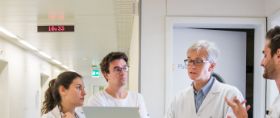
The indications and choice of the most appropriate procedure for the individual patient are discussed within an interdisciplinary Heart Team, which includes cardiologists, interventional cardiologists, and cardiac surgeons. These collegial evaluations may take place during the coronary angiography examination, if necessary by convening cardiac surgeons in the catheterization room, or in a more structured manner at the weekly Heart Team Meeting.
Diagnosis and treatment
Coronary artery surgery
Coronary artery bypasses, including using automated connectors and through mini-thoracotomy.
Coronary artery bypass is one of the most successful surgical procedures worldwide, and despite extraordinary advances in percutaneous coronary interventions, coronary surgery remains a cornerstone in the treatment of advanced coronary artery disease.
Our surgical planning and decision making are highly personalized and tailored to the needs of each individual patient. In most cases, coronary surgery is performed through the longitudinal opening of the sternum to gain access to the heart (median sternotomy). Normally, these operations are performed using the heart-lung machine, either with a stopped heart or a beating heart. When indicated, so-called "off pump" surgery, that is, without extracorporeal circulation, is adopted.
In selected patients, surgery can finally be performed by a minimally invasive technique, that is, through a small incision made at the level of the left lateral wall of the chest (left mini-thoracotomy) without the use of the heart-lung machine.
Among the most important aspects of our surgical planning is the prevention of complications during and after coronary surgery, such as neurological adverse events, acute bypass occlusion, and surgical wound infections.
Valve surgery
Aortic, mitral, and tricuspid valve surgery using reparative and replacement techniques and minimally invasive approach, including percutaneous and transapical (TAVI) treatment. Transplantation of cryopreserved human aortic roots (ascending aorta + aortic valve + aorto-mitral junction).
Due to significant and continuous improvements in science and technology, our standard surgical approach has evolved in recent years to the point where we now consider all patients as candidates for minimally invasive surgical approaches.
The techniques that allow minimally invasive surgical access to heart valves are diverse, but all are characterized by the fact that they allow, compared with the traditional approach, better chest stability and faster recovery of normal daily life after surgery.
Aortic valve
Our elective approach for aortic valve replacement and, if necessary, also for replacement of the initial, ascending segment of the aorta (in case of dilatation or aneurysm) is the mini superior sternotomy, which offers the advantages of reducing postoperative pain and the risk of wound infection.
In selected young patients with aortic valve insufficiency, as well as in selected patients with bicuspid aortic valves, the aortic valve can be preserved and repaired.
In selected cases, the intervention of first choice is cryopreserved human aortic root transplantation (ascending aorta + aortic valve + aorto-mitral junction).
Advances in the field of Trans-Catheter Aortic Valve Implantation (TAVI) have been impressive in the past decade. Despite several drawbacks, uncertainties and potential risks, this technique has the great attraction of being performed in a beating heart, without the need for extracorporeal circulation.
Mitral valve
Our standard approach to the mitral valve is right mini-thoracotomy, practiced in the surgical treatment of almost all patients with degenerative mitral regurgitation.
In all patients with degenerative mitral insufficiency, the goal of surgery is mitral valve repair, and the choice is always for the most appropriate technique with respect to the patient's specific anatomy. Our "successful repair rate," the success rate of valve reconstruction for degenerative mitral valve regurgitation, is more than 95%, and in more than 80% of patients, surgery is performed with minimally invasive techniques.
Tricuspid valve
Isolated tricuspid valve disease is a rare condition in adults. Surgical treatment is usually aimed at repairing the valve, either by implanting a specific rigid prosthetic ring or by "bicuspidating" the valve and/or by centrally suturing the three valve leaflets ("trefoil").
Aortic surgery
Surgical treatment of aortic axis aneurysm and aortic dissection.
Surgical treatment of heart failure
Implantation of Left Ventricle Assist Device (LVAD), ECMO, Impella, left ventricular remodeling techniques, myocardial revascularization and mitral valve plasticity, resynchronization.
Surgical treatment of atrial fibrillation
Minimally invasive or open surgical ablation (in combination with other procedure) to block the abnormal electrical circuits causing the pathology. Possible closure of the left auricle to reduce the risk of clot formation in case of fibrillation.
Patient services
Support services
Clinical and diagnostic services
Dedicated services
Insights
Internal EOC collaborations.
A close synergy between the Vascular Surgery and Angiology Service and the Cardiac Surgery Service has developed and is fully active at the Cardiocentro Ticino Institute. This collaboration spans multiple fronts, embracing the diagnostic dimension-with angiologists providing their expertise in the medical management of peripheral vascular disease-and the integrated therapeutic approach, in which vascular surgeons and cardiac surgeons work together for the management of specific thoraco-abdominal pathologies, both in planned and emergency settings. This synergy between medical specialties is strongly geared toward providing patients with high-standard care, ensuring effective, innovative, and highly targeted medical and surgical solutions.
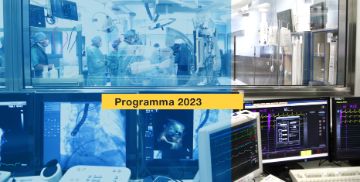
The hybrid operating room
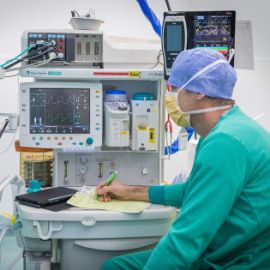
Hybrid operating rooms (today Cardiocentro has two available, the first of which is dedicated primarily to interventional cardiology) represent theevolution of traditional operating rooms, an evolution that has emerged under the dual impetus of 'technological innovation and, in the field of cardiology, of the consequent transformation of the three medical disciplines specifically concerned with the heart-cardiology, cardiac surgery, and cardiac anesthesia-which are increasingly integrated and interconnected. Only in a highly multidisciplinary setting, in fact, can the most modern therapies be offered: increasingly less invasive surgeries, increasingly effective cardiologic procedures.
Patient care today involves very different types of interventions both in degree of invasiveness and in methodology, interventions that can be conducted only by having supporting equipment and technologies, in the proper operative phase as well as in the diagnostic phase that is increasingly integrated and co-integrated with the former. A hybrid operating room offers all the possibilities technologies of intervention and diagnostics in a single environment, with obvious advantages also and above all for patient safety.
Trans-apical surgical treatment of valvular pathology
Although surgical treatment of valvular pathology now makes it possible to avoid the median sternal opening in many cases and to greatly reduce the thoracic incision, valve surgery requires the use of the heart-lung machine and remains an unproposable option for patients with a precarious clinical picture. Cardiologists and heart surgeons are therefore looking for new ways to make the surgery compatible with the high-risk patient. One such avenue is the "trans-apical" technique, which involves the introduction through the apex of the heart muscle of a catheter-mounted biological prosthesis. The prosthesis is advanced to the diseased valve and expanded there so that it overlaps and replaces it. With this technique, aortic valve replacement takes place in an extremely short time and without the need for extracorporeal circulation: the "weight" of the surgery, and consequently the risk, are greatly reduced.

Contact
Istituto Cardiocentro Ticino
Ambulatorio di Cardiochirurgia
Cardiocentro, Lugano
-
Orari di risposta al telefono
Monday : 08:00 - 17:00
Tuesday : 08:00 - 17:00
Wednesday : 08:00 - 17:00
Thursday : 08:00 - 17:00
Friday : 08:00 - 17:00
-
Chiusura dell’ambulatorio
Saturday
Sunday
Locations
Cardiac and great vessel surgery is an EOC clinical specialty offered by the Cardiocentro Ticino Institute at its headquarters in Lugano.